

The first study that bridged radiation biology and chronobiology was performed at the Bowman Gray School of Medicine in Winston-Salem (NC, USA) and published in the journal Science in 1963. Donald J. Pizzarello, Richard L. Witcofski, and E. Ann Lyons asked a simple question: is the outcome from a given irradiation the same if it occurred at day or at night?
Pizzarello DJ, Witcofski R, Lyons EA. Variations in Survival Time After Whole-Body Radiation at Two Times of the Day. Science. 1963;139:349–365.
Specifically, they irradiated rats with 900 roentgens from X-rays (approx. 7.9 Gy absorbed dose) given over the whole body. They designed the experiment in such a way to calculate the LD50/30 value, a measure that describes the lethal dose (LD) of radiation that would kill 50 percent of an exposed population (to account for individual differences in radiation sensitivity and death probability) over the course of 30 days (to account for the time delay of radiation effects to manifest and result in lethality versus survival). They performed the irradiations the same way at 9 a.m. and 9 p.m. and compared the LD50/30 values between both circadian time points.
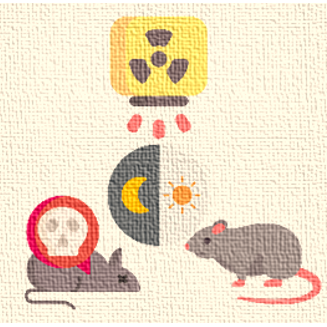
The result was striking: rats survived for more than 130 days when the radiation was administered in the morning. In contrast, the same dose killed all the animals within 13 days when given at night. More than six decades ago, the researchers demonstrated that a standard measure of acute radiation toxicity is profoundly influenced by circadian time. Yet this critical finding has not been integrated into radiation protection guidelines or clinical practice to date.